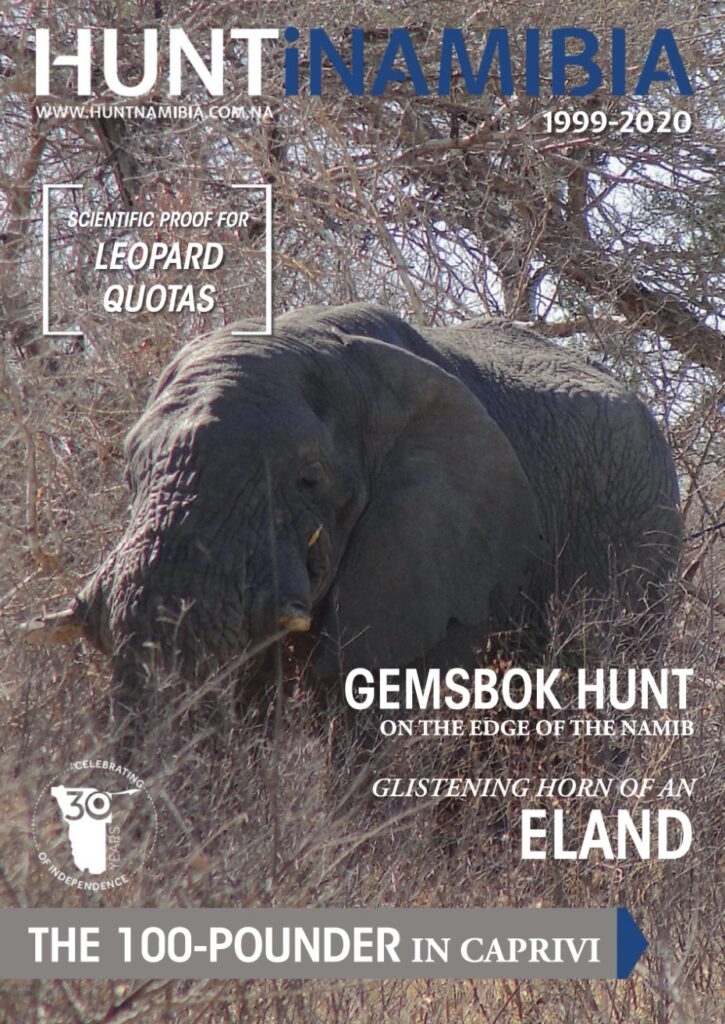
Over the past twenty years more really heavy tuskers have come out of Namibia than out of any other African country. Here follows the story around a truly outstanding trophy.
What an amazing fascination the African wilderness has – so unique in its diversity, its might and its beauty.
If at all, only the icy world of the high central Asian mountains could rival the mystical fascination of the black continent.
The ultimate symbol of this unbelievable fascination is perhaps the flashing glimpse of a big old tusker – a hundred pounder – turning away, the glimpse of a huge tusk as a cloud of dust engulfs the colossus before it disappears into the thicket. But the hundred pounder, this most imposing and magnificent of all hunting trophies on earth, seems to have disappeared.
An interesting article by the first-ever foreign trophy hunter to Namibia, Elgin Gates, appears in this edition of Huntinamibia. It is an article which touched me, because he clearly recognised and valued our fascinating country for what it is: an exceptional hunting paradise with relatively few, but several special species, such as kudu, gemsbok, Hartmann’s zebra and springbok. He compares Namibia favourably to the classical safari countries of east Africa.
During 1959 when Elgin Gates hunted in Namibia it was still possible to hunt elephant in 30 African countries. In those days Namibia was not one of them. The very first local hunting outfitter, Basie Maartens, who accompanied Gates as PH, writes in James Mellon’s 1975 African Hunter: “…at present some of our best hunting areas are… along our northern border… and along the Botswana border… Because these reserves may eventually be opened to hunting, we should note what wealth of game they contain.”
Today, twenty years later, elephant can be hunted in only seven African countries, of which Namibia is one. The northern border regions Maartens referred to back then have been opened to trophy hunting since. However, the hundred pounder seems to have disappeared from the African game fields.
In 1999 I thought I had reached the pinnacle of my career as a professional hunter when a client took an elephant trophy of just over a hundred pounds in eastern Kavango, west of the Khaudum Game Park. Tony Sanchez Arinho, probably the most knowledgeable expert on elephant hunting on the African continent, had this to say about that trophy: “In my opinion this means nothing at all, except that the hunter who took it had exceptionally good luck… It is totally unrealistic to dream of a hundred pounder nowadays.”
Since then, I have been hunting in the Nyae Nyae Conservancy, south of the Khaudum Game Park. During the first safari of the 2004 hunting season I had the right client for a real elephant hunt. Norman Kronseder was in perfect physical condition, mentally composed and an experienced elephant hunter. He took his first bull at the age of sixteen in the rainforest of Gabon and later in Ethiopia, Zimbabwe and Tanzania.
We approached the matter in a measured and composed manner. At the time, in July, after a good rainy season, there was still open water everywhere, also in the remote northern areas, along the border of the Khaudum, close to our camp.
It was to become one of the most outstanding elephant hunts of my life – a safari like no other. I will tell the story, not without reluctance, because nowadays to every good and every bad safari there has to be a dramatic story.
Every day we left camp on foot early in the morning to look for a good elephant track at the waterholes, returning to camp only at nightfall after a march of eight to ten hours. This may sound like the usual exaggeration, but it is the truth. During the hottest time of the day we settled down in the shade of some bushes and slept the sleep of the just. And so the days passed. Petra, Norman’s wife, accompanied us, she just as fit as her husband. On the first day we came upon a bull of more than seventy pounds. On the third day, we also tracked down a big bull. After careful consideration, we decided to search for a bigger one.
But then followed a long ‘drought’, lasting almost until the end of the safari when we eventually came upon a promising track again. Was it the bull moving about? We were close to the Khaudum border in a forested area with many waterholes, also frequented by cows and calves. Three days in a row in the early morning we found the large track at the waterholes and followed the spoor without being able to catch up with the bull. In the evenings, disheartened, we had to give up. Petra named him ‘the phantom elephant’.
On the second-last day of the safari we found the track again. However, we had difficulty deciphering it in the confusion of spoor around the waterholes, when suddenly, late in the morning, the bull came walking towards us – and this was the secret of our phantom elephant. He moved to the water at noon and when we searched for his spoor in the morning, he'd already had a head start of virtually a full day. Unfortunately the trophy did not live up to what the track had promised. It was a very average bull.
And so the last day of the hunt dawned.
We were out early, checking several waterholes without success. Thus we went on a long trek through the grazing area to find a good track – without success. We lay down in the shade for our customary afternoon nap, something one can only really do in the company of a client who knows this is done. And such clients still exist, believe me. At no point during the safari was there the slightest friction, despite exhausting, unsuccessful tracking and aching feet.
Of course, the safari had its highlights. On day three the bull with its long, dark tusks, was an impressive sight indeed. One day we came upon three wild dogs and another time one of the trackers almost stepped onto a sleeping leopard. Twice, around the campfire at night, we heard the distant, booming roar of lion.
Africa – what more could you wish for?
By now, however, after our afternoon nap of the last day, none of us expected to be successful. We made one last attempt on our march back in the afternoon, still heading diagonally to possibly encounter a bull on its way to the water. As the sunlight ebbed away, so did our hopes. With the sun almost touching the horizon, we suddenly found the fresh spoor of a group of bulls. They were moving just ahead of us.
All of a sudden we experienced a big adrenaline rush, but was it not too late? In great haste we hurried along and, whenever the tracks allowed, broke into a run, with anxious glances at the setting sun. Suddenly we catch up with them. They are seven bulls, standing motionless in a shallow pan. They have just bathed and had a drink and now stand clustered in the centre of the pan. In the commencing dusk everything is quiet and peaceful. All we hear is the sound of whistling wing beats in the air as the last doves leave the water. We encircle the waterhole to assess the bulls carefully, positioning ourselves in the bushes close by.
Norman and I have just discussed the trophy quality of an old bull standing at the fringe of the group when suddenly another bull pushes forward – and this is a big one, with thick, heavy tusks. He starts out in our direction with the rest following. We sneak towards them as the seven bulls, wet and shiny black after their bath, close in, in all their daunting might. A grand moment indeed.
The big one in front progresses to within twelve, fifteen yards when Norman brings him down with two quick shots from his double. In the dust of the panicking bulls we rush towards the fallen elephant. The ejectors of Norman’s double do not discard the cartridge cases. We quickly change rifles and from close range Norman administers the coup de grâce. The shot dies away in the dusk; the dust settles.
In this emotionally charged moment Norman makes a statement which gives me great pleasure: “For this I would give three Tanzanian elephants.”
Before us lay a bull with tusks of 76 and 72 pounds, an exceptional trophy for our times. One would, however, think that this safari would have deserved a hundred pounder. But then, luck is fickle and incalculable. After all, it is “totally unrealistic to dream of a hundred pounder nowadays”.
Three safaris later, on September 22, 2004. It is day three of a hunting safari with a German professor. Early in the morning we take up the spoor of a group of elephant bulls at a waterhole in the Te-Barku area in the far south west of the hunting concession. Amongst them is a very good spoor. It is hard to track, because we have to stick to the prominent spoor in case the group splits up. In the heat of the day, however, at two in the afternoon, we come up with three of the bulls. One huge bull towers over the other two, but we still cannot see the tusks. We outflank them and approach with a favourable wind.
At last we are upon them. The gigantic bull stands facing half away, showing his left side. The tusk is broken off. Then he turns to the right and the unfulfilled dream of generations of African hunters comes true – a gigantic, ponderous tusk, a hundred pounder.
It is one of those moments when no questions are asked and no discussions are held. I indicate that the client must load his rifle, and to his companion and the trackers to stay close by. We wind our way towards the elephants and the Giant of Te-Barku starts moving, showing us his left side. But with each of his swaying steps, a colossal tusk appears low behind the trunk. A thundering shot breaks the shimmering heat. Seconds later the Giant of Te-Barku is on the ground. Fickle, incalculable luck has struck unexpectedly.
The game ranger at Tsumkwe weighed in the gigantic right tusk at 115.3 pounds; its length was 195 centimetres and circumference 60 centimetres at the lip – a world sensation in hunting; the biggest tusker to be taken on the African continent in 19 years.
A few days later we heard that a Canadian prospecting company had found indications of rich diamond deposits in Khaudum Game Park – shattering news. What will become of one of the last retreats for big tuskers in Africa? In 1959 there were 30 countries allowing a sustainable utilisation of elephant populations. Seven are left. The rest have been eaten up by development. In future, only time will tell whether this country will still have what impressed Elgin Gates way back in the fifties. by Kai-Uwe Denker