My Venture Publications
  Home | Travel News | Flamingo | Huntinamibia | Namibia Holiday & Travel | Travel Planner | Photo Gallery | About Us | Contact Us  
        You are here: Home > Huntinamibia      
 
  Travel News  
  Huntinamibia  
  English  
  - Home  
  - Game Species  
  - NAPHA Info  
  - Namibia Adventure  
  - Publication Archive  
  German  
  - Home  
  - Wildarten  
  - NAPHA Info  
  - Namibisches Abenteuer  
  - Publication Archive  
  Flamingo  
  Holiday & Travel  
  Travel Planner  
  Photo Gallery  
  About Us  
  Contact Us  


Huntinamibia


  Topics:  
     
 
NAPHA holds AGM (29.11.2011)
Uaheko Herunga, deputy minister of MET, delivered the opening speech at the annual general meeting for the Namibia Professional Hunting Association (NAPHA), held in Windhoek on 22 November 2011.

“Namibia is committed to the sustainable use of wildlife resources, as is indeed provided for in our national constitution. Sport or trophy hunting is the result of good conservation and good wildlife management, and it is our collective interest to ensure that we use this resource sustainable. Trophy hunting lends itself to being a sustainable way of using wildlife, since this form of hunting is aimed at a small portion of a population, typically the surplus adult animals, usually males.

Trophy hunting in Namibia is regulated by law. Regulations relating to Nature Conservation provides for different categories of trophy hunting guides, namely Hunting Guides, Master Hunting Guides, Professional Hunters, and Professional Hunters for Big Game. While Hunting Guides and Master Hunting Guides are restricted to hunting farms, the higher categories of Professional Hunter and Professional Hunter for Big Game are allowed to hunt anywhere in Namibia through concessions or in conservancies. All those who want to register in the different categories follow the procedure and approval as described by the regulations. We will continue to put measures in place to avoid any violation of our trophy hunting regulations and curb illegal hunting. For that the Ministry has a new staff structure, which will be fully implemented in April 2012. The new structure will enhance regional decision-making and coordination. It is designed to help build stronger teams at our regional and park offices in order to efficiently and effectively enforce our legislation, execute planning and engage with other stakeholders.

Namibia has a proud conservation record, which is recognised internationally. This reputation rests on the commitment to the conservation of biological diversity through the establishment and management of protected areas, but also partly on conservation outside parks.

To some persons, especially in the urban areas of developed countries, it may not be obvious that there could be any positive link between biodiversity conservation, hunting, tourism and rural development. For millennia, people have relied on ecosystems to meet their basic needs for food, water and other natural resources. Preserving these natural systems is thus so vital for our national development, our livelihoods, and indeed our very survival, that our rural poor and the entire nation benefit from these resources.

Much of Africa, including Namibia, had lost large components of its wildlife over the last century, for a variety of reasons. Post-independence instability in some countries and problems with governance in general, are well known to have exacerbated this further. Within the last decades, the continent lost most of its elephants; almost all of its rhinos; and many other species became confined to protected areas such as national parks.

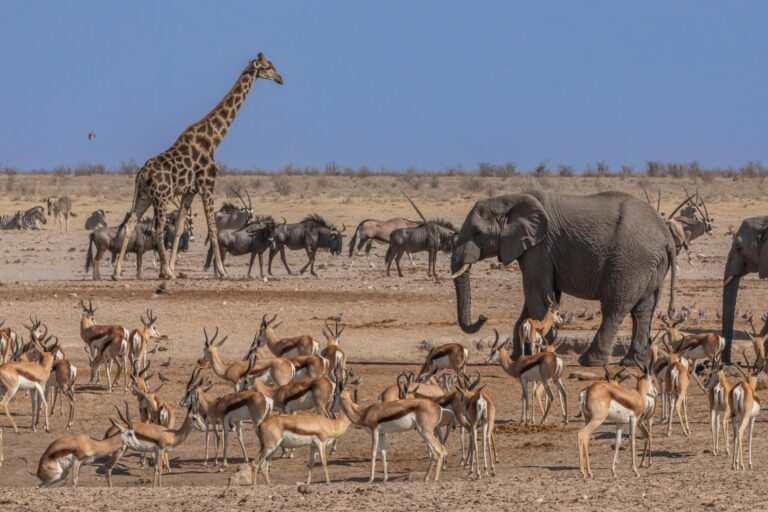
However, it is also true that some countries and some Governments in Africa have reversed this trend very successfully, and that wildlife is recovering or has recovered. In Namibia, for example, there are currently greater numbers of wildlife than any time in the past hundred years. There is more than twice as much wildlife outside our protected areas than inside them. Our elephant population has virtually quadrupled over the last twenty years to about twenty thousand and we now have more than one thousand black rhinoceros, to mention just a few.

Livelihoods of conservancy members are receiving boosts through a number of means. The meat from trophy hunted game and animals harvested for own use is substantial. Similarly, each job created provides valuable livelihood benefits to direct family members and indirect benefits to extended family members.

I am aware that hunting on concessions on State land comes to an end this year. We will soon announce the concessions where hunting will continue or can still be awarded for the next few years and the number of animals thereof. We are currently reviewing the progress and challenges we had in these concessions over the past three years, to enable the Ministry to make good decisions.

By now it has become common knowledge that tourism in general, and trophy hunting in particular, has grown to be one of the most important assets to Namibia in terms of its strong contribution to the Gross Domestic Product, employment creation and the well-being and social upliftment of our rural people.”


read more >


Focus on the benefits of hunting (29.09.2009)
“Hunting is the perfect tool to assist developing nations to achieve a higher level of development.” This statement by the president and founder of the IWMC World Conservation Trust, Eugéne Lapointe, was made at the first-ever symposium on the ‘Ecological and Economic Benefits of Hunting’, held in Windhoek from14–17 September.


read more >


Moratorium on cheetah and leopard hunting until 2010 (01.08.2009)
The Ministry of Environment and Tourism suspended the issue of hunting permits for cheetah and leopard for the remainder of the 2009 hunting season in Namibia, because the CITES export quota had been exhausted. NAPHA request MET to suspend leopard hunting with hounds in Namibia and not to issue permits for 2010 until control mechanisms are in place.


read more >


Camp Boss (01.08.2009)
Advice for the PH’s new bride

Although your partner will always have centre stage, your role as leader of the back-up team is essential to the success of the hunting operation — you are the heart and soul of the safari company!


read more >


The King of the Kalahari (01.06.2009)
The following article written by Elgin Gates was published in 1963 in the Outdoor Life Magazine, when Namibia was still referred to as South West Africa and the hunting sector was yet to develop and become the major earner of foreign exchange it is today. This article holds a lot nostalgic memories for ‘old hands’ of Namibian hunting and for anyone interested in sustainable use principles, it contains very interesting information on the origin and development of trophy hunting as a conservation tool.


read more >


The Giant of Te-Barku (01.06.2009)
Over the past twenty years more really heavy tuskers have come out of Namibia than out of any other African country. Here follows the story around a truly outstanding trophy.

read more >


He was all mane (01.06.2009)
While lion populations are on the decline almost all over Africa, Namibia is in the fortunate position of showing an increase, especially in the north-western communal areas – a result of the successful conservancy policy.

read more >


Message from the Ministry (01.06.2009)
Maintain a competitive advantage

For trophy hunters from all over the world who consider Namibia as their preferred African hunting destination, I have this message: The Government of Namibia will ensure that our country will not lose its esteem in the world of trophy hunting and we will strive to maintain our competitive advantage at all times.

read more >


  Wishlist  
view all >
  Save Wishlist  
 
  Travel Planner  
>> Packages
>> Info Box
>> Wish List
 
  Travel News  
 
  Photo Gallery  
Flamingo Covers 2009
  Desert detritis from Flamingo Covers 2009  


© Venture Publications 2009 - Designed and Developed ProDG   Intouch, maintained by iWits Web Development